Concrete lifting in San Diego: raising a sunken slab, not the house

A driveway, patio, garage floor, or walkway that has sunk or gone uneven is a flatwork problem — the slab has settled into the ground beneath it. Concrete lifting in San Diego addresses that slab directly. It is a separate question from whether the house itself is level, even when the same soil movement caused both.

Describe the sunken slab
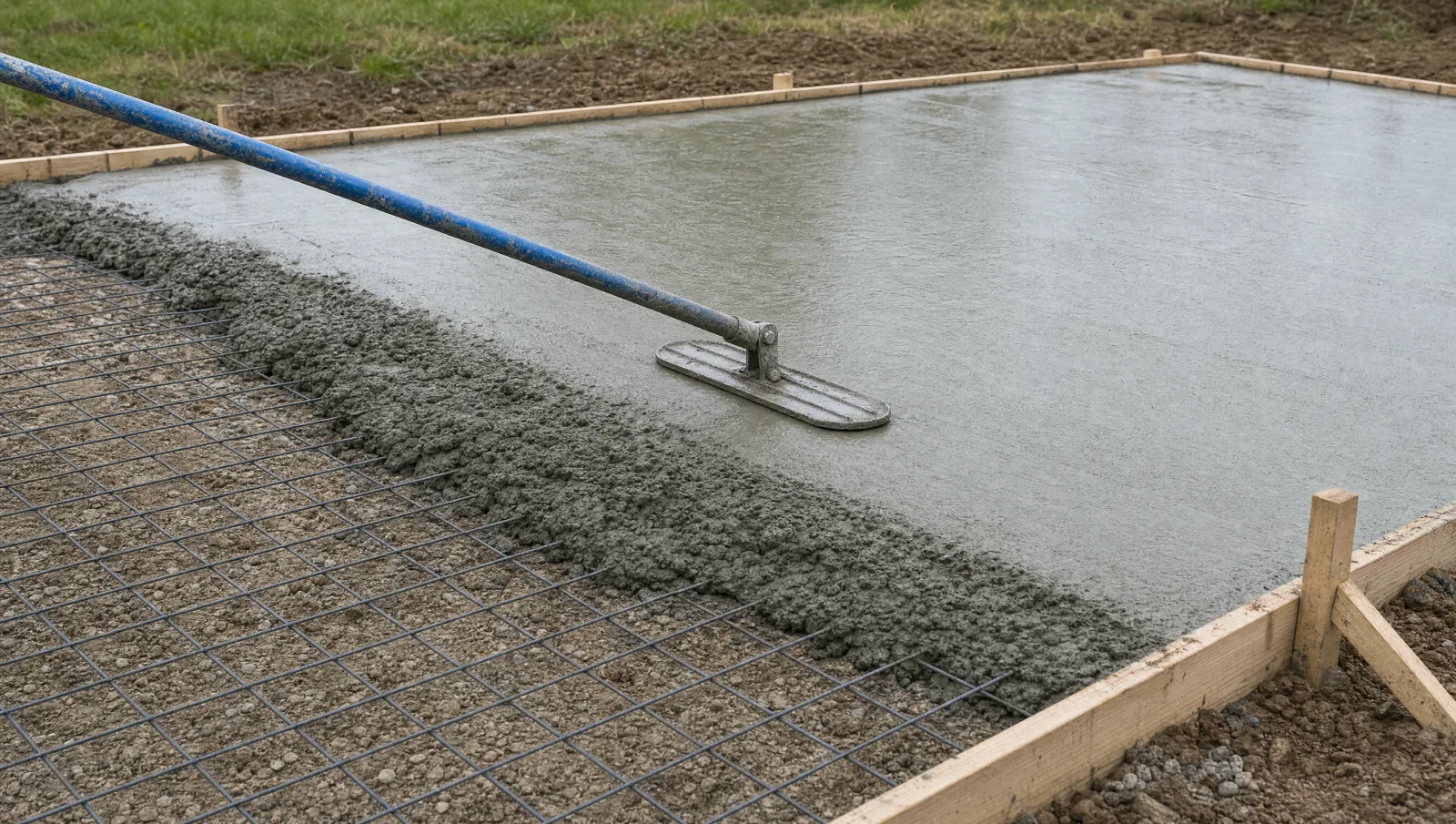
Illustration of a poured concrete slab installation in progress, with wet concrete being leveled by a bull float, wooden forming boards at the edges, and wire mesh reinforcement visible beneath the surface.

Signs this is a slab problem, not a house one

  • A driveway, walkway, or patio section that has visibly sunk relative to the restThe clearest version of the complaint this page answers — one slab section lower than its neighbor, with a lip or step between them.
  • A garage floor slab pulling away from the foundation wall or door thresholdGarage slabs are frequently poured separately from the house foundation and can settle independently, which is exactly the flatwork-versus-structure distinction this page exists to draw.
  • Water pooling on a patio or walkway that used to drain away from the houseSettlement changes the slope of a slab even when the sinking itself is subtle, and standing water against a foundation wall is worth addressing before it becomes a drainage or waterproofing issue.
  • A trip hazard at a slab joint or expansion seamAn abrupt height difference at a joint, rather than a gradual dip, points toward one section settling independently of its neighbor — a specific and often localized cause.

Why a sunken slab is not a foundation question

Concrete lifting addresses flatwork: driveways, patios, walkways, and garage floors that sit on their own base of soil or fill, independent of the house's load-bearing foundation system. When that base settles, erodes, or compacts unevenly — often from water movement underneath, poor original compaction, or tree root activity — the slab above it follows the ground down. The house frame itself is a separate structural system and is not necessarily affected just because a nearby slab has sunk. That said, the two are not unrelated: the same soil conditions that undermine a driveway slab can, over a longer timeline, affect a house foundation too. Where a visitor is not sure which one applies, see house-leveling for the structural side of that same question.
How the cause of the settlement gets identified

  1. Measure how much and where the slab has movedA single low corner reads differently than an entire section sunk uniformly — the pattern of settlement narrows down the likely cause underneath.
  2. Check what is under and around the slabVoid space under the slab, saturated or eroded soil, and nearby tree roots all point toward different underlying causes, and the lifting method depends on which one is actually present.
  3. Look at water sources near the affected slabA downspout draining under a driveway edge, an irrigation line, or a drainage path that changed over time is a common and fixable cause of the soil erosion driving the settlement.
  4. Confirm the slab itself is structurally sound enough to liftA badly cracked or broken slab may not be a good candidate for lifting versus replacement — this is assessed before a method is proposed.

The two general ways a sunken slab gets raised

Polyurethane foam lifting

Fits when: The slab is structurally sound and the goal is raising it back to level with minimal disruption.

Trade-off: Fast to cure and leaves a small injection footprint, though it depends on there being enough intact slab to lift evenly rather than crack further.

Mudjacking (cement-based slurry lifting)

Fits when: A larger void needs to be filled along with raising the slab.

Trade-off: Heavier material than foam, which can mean a longer cure time and a heavier load added under the slab — a real consideration on already-soft soil.

Slab replacement

Fits when: The concrete itself is too cracked or deteriorated to lift, regardless of what is happening underneath it.

Trade-off: Addresses both the surface and the base at once, at the cost of being a full removal-and-repour rather than a lift of what already exists.

What the process typically looks like

  1. On-site assessment of the slab and the soil condition underneathIncludes checking for water sources, void space, and the slab's own structural condition.
  2. Selecting a lifting method against that assessmentFoam, mudjacking, or replacement — the choice follows from what is actually found underneath, not a default.
  3. Drilling small access points, for foam or mudjackingInjection points are placed to lift the slab evenly rather than at a single spot, which would risk cracking it further.
  4. Lifting to level and confirming the resultThe slab is raised incrementally and checked against level as it goes, rather than in one uncontrolled push.
  5. Addressing the water source, if one was identifiedFixing the drainage or grading issue that caused the settlement is what keeps the same slab from sinking again.

What actually moves the number on a slab-lifting job

Size and number of slab sections affected

One sunken driveway apron is a different scope than a full driveway plus a patio plus a walkway.

How much void space or soft soil is under the slab

A larger void needs more material to fill before the slab is actually supported, independent of how far it needs to be lifted.

Lifting method chosen

Foam and mudjacking use different materials and equipment, and the right one depends on the diagnosis, not preference alone.

Whether the underlying water or drainage issue also needs to be addressed

Lifting the slab without addressing what caused it to sink is a repair that is more likely to need revisiting.

Where this applies across San Diego County

Driveways, patios, and garage slabs settle for the same soil and drainage reasons across San Diego County's varied terrain, from coastal flatwork to hillside lots where grading and runoff patterns differ street to street.

  • San Diego
  • Chula Vista
  • El Cajon
  • La Mesa
  • National City
  • Escondido
  • Oceanside
  • Carlsbad

What this page will not tell you, and who should

Concrete lifting is generally a lower-risk category of work than structural foundation repair, but it still depends on judgment calls this page will not make for a specific property — whether a cracked slab is safe to lift versus needs replacing, how deep a void actually extends, or whether nearby soil conditions suggest a bigger problem than the visible slab. Those calls belong to whoever is actually on site, not to a general description of the category.

Permit requirements for flatwork repair vary by jurisdiction and scope and are not something this page states as settled for any particular address. For how independent providers relate to this site and what submitting a request actually does, the contractor matching disclosure page covers that plainly.

Questions people ask

Does a sunken driveway mean my house foundation is also settling?

Not necessarily. Driveway and patio slabs typically sit on their own base, separate from the house's load-bearing foundation, and can settle independently. If there are also signs of movement inside the house — see house-leveling for that structural side — it is worth having both looked at, but one does not automatically imply the other.

Is concrete lifting permanent?

It raises the existing slab back to level, but if the underlying cause of the settlement — usually water or eroded soil — is not addressed, the same section can settle again over time. Fixing the source, not just lifting the slab, is what makes the result last.

How is mudjacking different from foam lifting?

Mudjacking uses a heavier cement-based slurry, which can fill larger voids but adds more weight under the slab and generally takes longer to cure. Foam is lighter and cures faster, but depends on the slab having enough sound concrete to lift evenly. Which one fits depends on the diagnosis.

Can a badly cracked slab still be lifted?

Sometimes, but not always — a slab that is too deteriorated to lift as one piece is usually a replacement candidate instead. That assessment happens on site, not from a description alone.

Describe the sunken slab

Which slab is affected, how much it has settled, and whether there's a visible water source nearby.

Request Service